
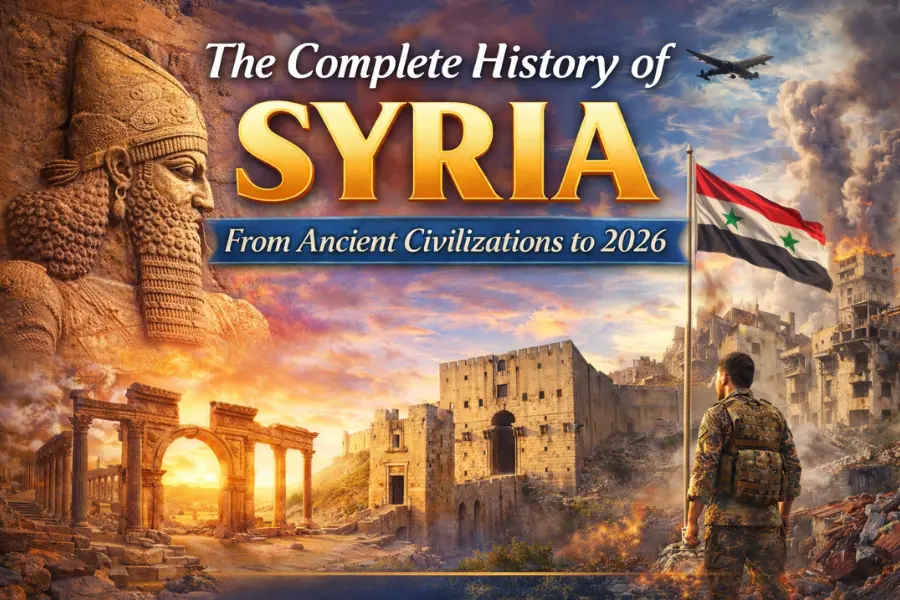
Syria’s Epic History: From the Cradle of Civilization to Modern Turmoil
Few places on Earth hold as much historical depth as Syria. Often described as one of the cradles of civilization, this Middle Eastern land has witnessed the birth of writing, the rise and fall of powerful empires, and the shaping of cultures that influenced the entire world.
From ancient trading cities and early alphabets to modern conflicts that have captured global attention, Syria’s story is complex, dramatic, and deeply significant. Understanding Syria means exploring thousands of years of human history layered across deserts, fertile plains, and legendary cities.
This guide explores Syria’s extraordinary past, its cultural importance, and the challenges it faces today.
Syria: A Cradle of Early Civilization
Long before many famous civilizations emerged, the land of Syria was already home to thriving communities and advanced societies. Archaeological discoveries reveal that some of the world’s earliest urban settlements developed here.
One of the most remarkable sites is Tell Brak, where evidence shows organized settlements thousands of years before many well-known ancient cities.
Another groundbreaking discovery came from the ancient city of Ebla. Excavations uncovered thousands of clay tablets written in early cuneiform script, providing insight into trade networks, politics, and daily life of early civilizations.
Amazing fact: Some historians believe early administrative writing systems used in Ebla influenced the development of later alphabets.
These early societies traded with Egypt, Mesopotamia, and Anatolia, making Syria a crucial bridge between continents and cultures.
Syria as the Crossroads of Ancient Empires
Because of its strategic location between Asia, Europe, and Africa, Syria became one of the most contested regions in ancient history. Powerful empires repeatedly fought for control of its cities, trade routes, and fertile lands.
Among the first conquerors were the Akkadian Empire, followed by the Hittite Empire and later the Neo-Assyrian Empire.
One of the most famous ancient battles took place near Syria — the legendary Battle of Kadesh. This massive confrontation between Egyptian and Hittite armies became one of the earliest recorded military conflicts in history.
Amazing fact: The peace treaty signed after this battle is considered one of the oldest known international peace agreements.
During this period, Syria’s cities flourished as hubs for merchants, artisans, and scholars.
Syria Under Greek, Roman, and Byzantine Influence
When Alexander the Great expanded his empire across the Middle East, Syria became part of the Hellenistic world. Greek culture, language, and architecture blended with local traditions.
After Alexander’s empire fragmented, the Seleucid Empire controlled much of Syria, building grand cities and spreading Greek influence throughout the region.
Eventually, the powerful Roman Empire took control. Under Roman rule, Syrian cities became wealthy trade centers linking Mediterranean markets with Asian caravans.
Some of the region’s most spectacular ruins still stand today — including theaters, temples, and colonnaded streets that reflect Syria’s importance within the Roman world.
Later, Syria became part of the Byzantine Empire, continuing to serve as a center of religion, commerce, and scholarship.
Amazing fact: Several early Christian communities formed in Syria, and ancient churches here played a major role in spreading Christianity across the region.
Read also: The Ultimate Guide to Opatija: Belle Époque Charm & Adriatic Strolls
Syria and the Rise of Islamic Civilization
A major turning point in Syria’s history came when Arab armies captured Damascus and other cities during the early Islamic expansion.
Soon afterward, Damascus became the capital of the Umayyad Caliphate — one of the most powerful empires of the time.
From Damascus, the Umayyads ruled territories stretching from Spain to Central Asia. During this era, Syria became a major center of art, science, architecture, and trade.
The famous Umayyad Mosque still stands as one of the most important and beautiful Islamic landmarks in the world.
Amazing fact: The Umayyad Mosque contains relics associated with multiple religious traditions, symbolizing the region’s deep spiritual heritage.
Medieval Syria: Crusades, Mongols, and Ottoman Rule
Syria’s strategic location again made it a battleground during the medieval era. European crusaders captured parts of the region, leading to centuries of warfare between Christian and Muslim forces.
Later, the Mongol Empire swept through parts of the Middle East, leaving destruction in its path. Eventually, Syrian territories came under the control of powerful regional dynasties before being incorporated into the vast Ottoman Empire.
Under Ottoman rule, Syria remained an important trade and cultural center for centuries, connecting Mediterranean ports with inland caravan routes.
Modern Syria: Conflict and Global Attention
After the collapse of the Ottoman Empire, Syria entered a new political chapter under European influence before eventually gaining independence.
In later decades, political shifts and leadership changes shaped the country’s modern governance. The leadership of Bashar al-Assad became central to the country’s political landscape.
Protests eventually escalated into a prolonged civil conflict that dramatically reshaped Syria’s society and economy. Multiple international actors, regional groups, and internal factions became involved, making the conflict highly complex.
Millions of Syrians were displaced during the fighting, and many cities suffered significant damage.
Despite ongoing challenges, humanitarian efforts and reconstruction discussions continue in various regions.
Amazing Facts About Syria
• Syria is home to some of the oldest continuously inhabited cities in the world, including Damascus.
• Ancient Syrian traders helped connect Mediterranean markets with Silk Road routes.
• Some of the earliest alphabets developed in this region influenced modern writing systems.
• Syrian cuisine — including dishes like hummus and falafel — has become popular worldwide.
• Historic Syrian architecture blends Roman, Islamic, and Ottoman influences in unique ways.
Syria’s Cultural Legacy
Even amid modern challenges, Syria remains one of the most historically important regions on Earth.
Its contributions to language, religion, trade, and architecture shaped civilizations far beyond the Middle East.
Understanding Syria’s past reveals how deeply interconnected human history truly is — and why protecting cultural heritage remains vital for future generations.